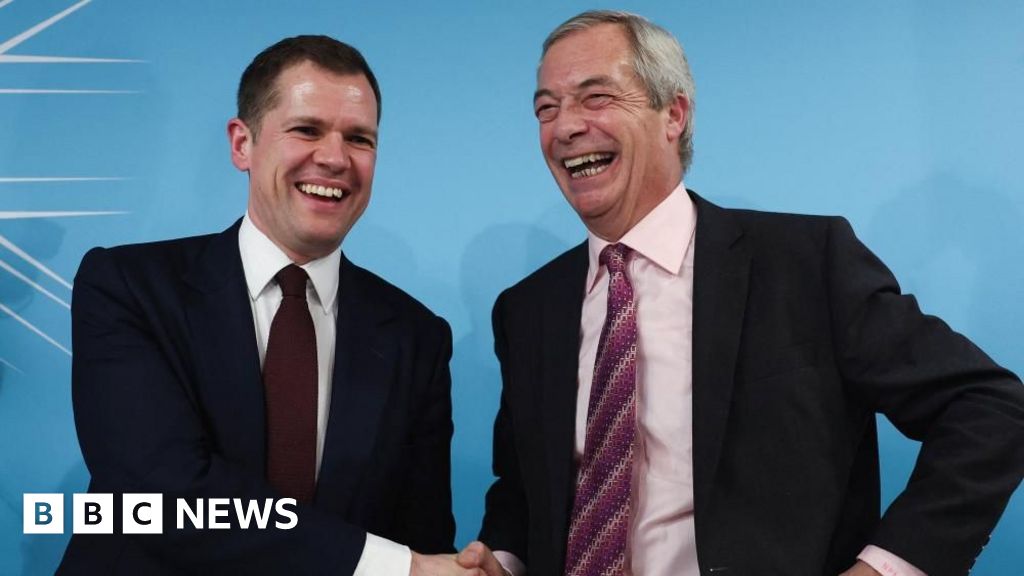
The key moment of Robert Jenrick’s defection to Reform UK had it all.
It was politics at its most raw: where choreography hasn’t had time to get its boots on.
Hundreds of us were crammed into a room at Reform HQ designed for far fewer – and then when Nigel Farage unveiled his latest recruit, there was no sign of him.
Jenrick managed to be late to his own defection, in the latest dollop of farce on a day groaning with drama, jeopardy, skulduggery and plotting.
It was a day which began with a tactical masterstroke from the Conservative leader Kemi Badenoch, who got wind Jenrick was going to jump ship so pushed him overboard herself.
But strategically it is Reform showing regular momentum and magnetism — to plenty of Conservatives at least.
This is a pivotal waymarker in the remoulding of the Right of British politics.
It is the biggest coup for Farage so far and will help him take on the jibe from his opponents that Reform is a one man band.
The Conservative Party, so long the leviathan of British politics, had already been crushed by the electorate and had already been leaking like a burst pipe towards Reform.
Now it has now lost one of its most high profile figures.
There are, inevitably, cries of betrayal from Robert Jenrick’s former colleagues, who are now indulging in the ritual sledging of his character.
“He was overwhelmed by personal ambition in a Macbeth type way,” one shadow cabinet minister claimed.
Jenrick responded that given he had been the bookies’ favourite to be the next Conservative leader and was now joining a party with a very prominent and successful leader, it was a bit rich to put this all down to personal ambition.
Nigel Farage now faces a familiar critique – that given the number of Tory defectors he is welcoming, does he really lead the Conservatives 2.0 rather than a distinctive, new, insurgent force?
He told me they had welcomed a former Green councillor this week and would unveil a Labour defector next week.
But is undoubtedly true that the vast majority of Reform’s recent high profile signings are former Conservatives.
It is a perception the party knows it has to manage astutely.
And Labour were quick to point out the various past moments where Nigel Farage had been incredibly critical of Robert Jenrick.
But, in short, defections and how they appear are a nice problem for a party to have – and far better than the alternative.
A final thought: I wonder what the medium and long term consequences there may be of Kemi Badenoch’s ruthlessness in giving Robert Jenrick the boot.
Nigel Farage said he had thought it was 60/40 Robert Jenrick would join his party.
60/40 isn’t much better odds than tossing a coin. And yet there he was. What conversations between the two men, which may have happened in the coming days, weeks or even months, had to be rushed in a matter of hours after Badenoch’s intervention?
And what trouble could that store up for both men in the months ahead? Let’s see.